Hamilton County, TN & North Georgia · IECC Climate Zone 4A Specification
Spray Foam Insulation (Open-Cell & Closed-Cell)
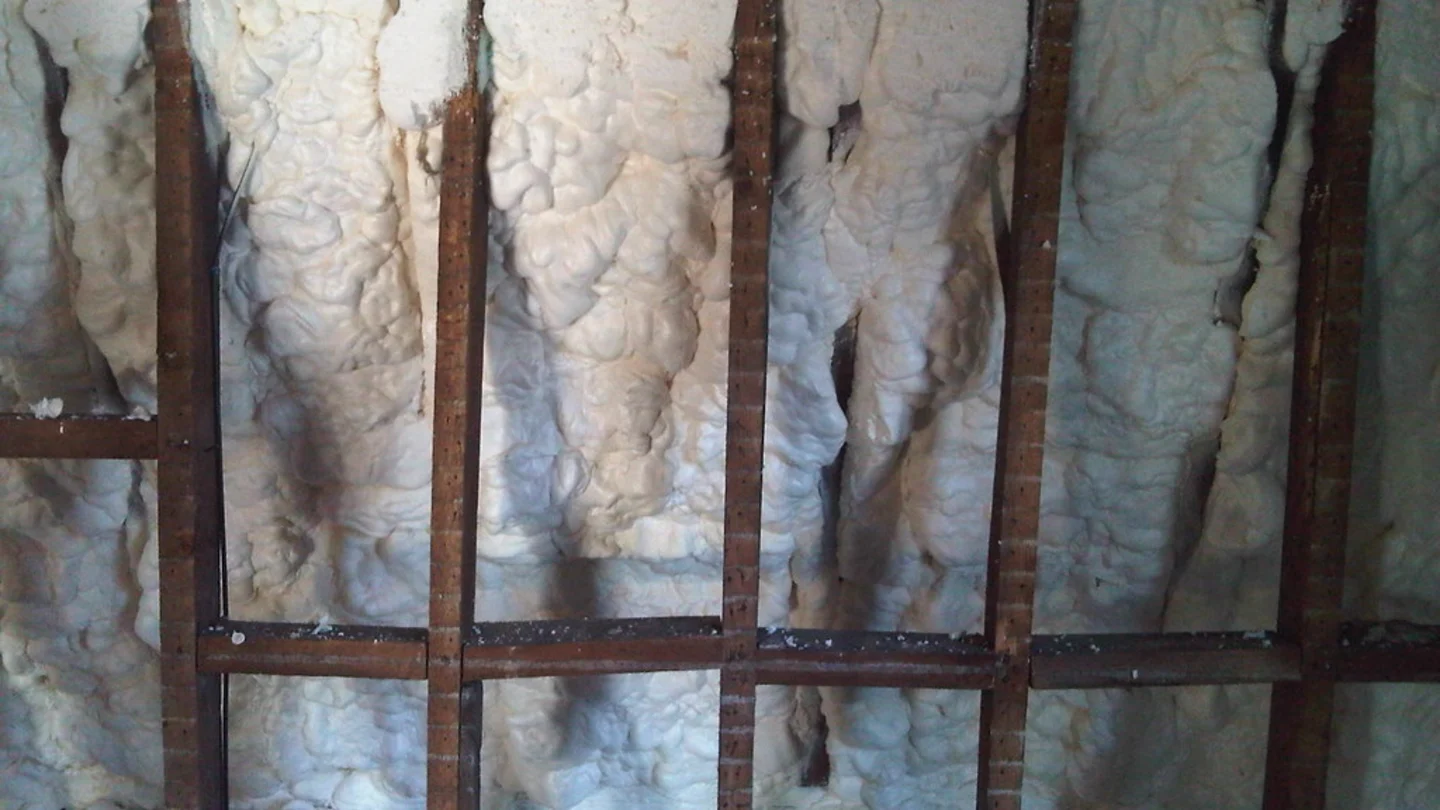
Open-cell and closed-cell spray polyurethane foam that air-seals and insulates in a single step for attics, walls, bonus rooms over garages, and cantilevered floors across the Tennessee Valley.
Quick answer
Open-cell and closed-cell spray polyurethane foam that air-seals and insulates in a single step for attics, walls, bonus rooms over garages, and cantilevered floors across the Tennessee Valley. In IECC Climate Zone 4A, closed-cell foam's Class II vapor retarder lets us seal rooflines without a separate vapor retarder — critical for humid Chattanooga summers where vented assemblies sweat.
Scope of work
- ✓Open-cell spray foam (≈R-3.7/inch) for sound damping and whole-cavity air sealing
- ✓Closed-cell spray foam (≈R-6.7/inch) for maximum R-per-inch and a built-in vapor retarder
- ✓Roofline (unvented) and exterior wall applications
- ✓Bonus rooms over garages and cantilevered floor isolation
- ✓Rim-joist sealing at the foundation line
- ✓Air barrier continuous from roof deck to slab
Performance in IECC Climate Zone 4A
In IECC Climate Zone 4A, closed-cell foam's Class II vapor retarder lets us seal rooflines without a separate vapor retarder — critical for humid Chattanooga summers where vented assemblies sweat.
What drives project pricing
| Open-cell (whole attic roofline) | Typically $1.50–$2.25 per board foot |
|---|---|
| Closed-cell (attics, walls, rim joists) | Typically $2.25–$3.50 per board foot (nominal $2.75/bf) |
| Minimum mobilization | Small jobs billed at a trip/mobilization minimum |
Ranges are typical for the Chattanooga market before incentives; a locked quote needs an on-site measurement.
What a complete quote includes
- ✓On-site measurement of conditioned area and access difficulty
- ✓Open-cell vs. closed-cell recommendation for your assembly
- ✓Board-foot estimate and total material + labor price
- ✓Vapor-retarder and ventilation plan for your assembly
- ✓Timeline and crew schedule
Frequently asked questions
- Open-cell vs. closed-cell spray foam for a Chattanooga attic — which is better?
- For a vented attic floor, either works. For a conditioned (roofline) attic in humid Zone 4A, closed-cell is usually the safer pick because it adds a Class II vapor retarder at the sheathing. Open-cell is excellent for sound control and whole-house air sealing where a separate vapor strategy is in place.
- Can you spray foam over existing attic insulation?
- Only if the existing material is dry, clean, and uncompressed. We typically vacuum out old fiberglass or cellulose first so the foam bonds to the substrate and we don't trap moisture against the ceiling deck. Each case is evaluated on site.
- What R-value does spray foam hit per inch?
- Open-cell is about R-3.7/inch (0.5 lb density) and closed-cell is about R-6.7/inch (2.0 lb density). Because both also stop air leakage, the effective performance is far higher than the labeled R-value of fiberglass at the same thickness.
Get a free on-site estimate
Fast quotes, honest recommendations, and no obligation. We'll match you with a vetted local insulation and crawl space specialist for your project.